- Parkland
The house built on a new site in 1822 by Thomas Lee, a Barnstaple architect, for Newton Fellowes. It was an early example in the county of an embattled Tudorstyle for a country house. It was dismantled in 1917. Now an eminently picturesque large ruin standing against the sky, surrounded by the woods of the Taw valley, like thebest of follies.
Revd John Swete visited in 1796 and wrote that ‘the landscape had nothing in it of the wild, or romantic, it was a sweetly-pleasing picture, touched by the soft, the minute, the elegant pencil of nature. Art did not seem to me to have used much of its interference in the embellishment of this little paradise.’ In 1806 Polwhele wrote that it was ‘built about the year 1718 of brick, much increased and improved by the present possessor who has also laid out the grounds about it with much elegance and taste under the direction of the late Mr Richmond; woods well interspersed, considerable plantations and the river Taw contributing much to enrich and beautify the scene.’
White (1850) noted that ‘Old Eggesford House was the seat of the Iords Chichester in the 17th century, and was rebuilt by W. Fellowes, Esq., in 1718, but was taken down about 26 years ago. The present seat of the Hon. Newton Fellowes is a neat mansion, standing in the adjoining parish of Wembworthy. ’ Stockdale described it as ‘lately taken down’. The sale particulars of 1913 particularly noted the walled kitchen gardens of three acres while that of 1914 noted the mile long drive and that the walks were noted for the specimen trees. The Parkland survives. Within the former grounds are a nursery and garden.
For more details see the Eggesford House Report.
Cherry & Pevsner: The Buildings of England – Devon, 1989: 352,
T Gray: The Garden History of Devon,1995: 71,
T Gray: Devon Country Houses and Gardens Engraved Vol I, 2001: 109
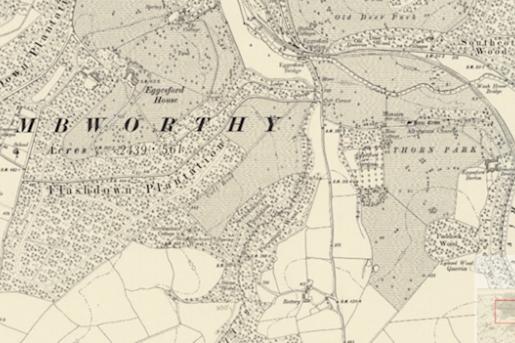
50.8863429, -3.8848243
Overview
A house, park, and garden with strong associations with the nationally significant Portsmouth family. Remodelled by the current owner, the house and its surrounding park, look over the valley to the original site of the earlier Chichester/Fellowes mansions, of which nothing remains. The walled kitchen garden, associated with both locations, is reported separately.
Archaeological interest
The archaeological interest and potential in part arises from evidence relating to lost buildings and features relating to the 1835 landscape, particularly elements of the garden and stretches of the main approach, paths and borders. The early medieval Heywood and Eggesford castles were incorporated into the plan of the period possibly as picturesque incidents on the drive around the estate.
Architectural interest
The nineteenth-century Tudor-gothic style house had fallen into significant disrepair but recent adaptations have integrated a new style of habitable construction within it. There are still significant losses but the panoramic views from the house have been restored. The nearby Cottage, a possible cottage orné, now known as Heyswood House, is in separate ownership.
Artistic interest
Vestiges of the pleasure garden remain with a terraced lawn leading out to the ha-ha. The original garden was not extensive or ornate, and few shrubs and a few roses remain. The park still has significant specimen trees and the surrounding woodlands are extensive. Much of the previous landscape is in the hands of Forestry England.
Historic interest
The surviving historic documentation is important to establish the development and significance of both the current and original sites. Each had associations with a nationally important and influential family, and links to notable Devon families. Swete visited the original site during the late eighteenth-century, recorded by two watercolours in his travel diary. Polwhele visited two years later, commentating on Nathaniel Richmond's recent improvements, a claim that has now been substantiated. William Lucombe and latterly his son, John, were also employed by the family. The current site was largely used for sporting activities, for which the family were well known, and this is reflected in the landscape. The notorious Eggesford Hunt still functions today.